
Intro
It may seem unthinkable to humans, but for many animals, losing a limb and growing it back in a matter of weeks is entirely normal. From salamanders that can grow entire legs to starfish that can grow new arms, there are amazing species throughout the animal kingdom that have the ability to regenerate body parts. In addition to helping them withstand wounds and predators, this remarkable ability gives researchers insights into regeneration and healing that may one day help people. The realm of regeneration demonstrates how amazing and robust nature can be.
Starfish
The ability to regenerate lost limbs and, in certain species, an entire body makes starfish masters of regeneration. The process of wound healing and tissue reconstruction starts as soon as an arm is severed. Like stem cells, undifferentiated cells assemble at the site of injury to form a blastema, which forms the new body part’s base. These cells multiply and differentiate into all the required tissues, such as muscles, nerves, and tube feet, over a period that may range from a few months to more than a year. Because starfish can purposefully remove an arm to evade predators, this amazing ability is essential for survival.
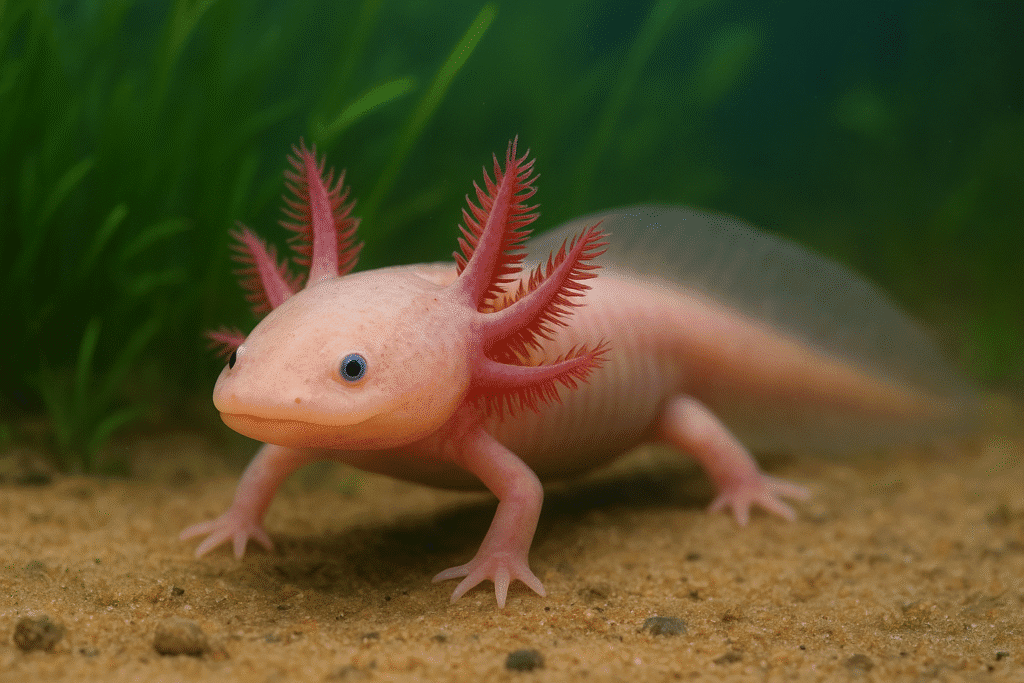
Axolotl
This process helps the axolotl resist predator attacks and maintains its health throughout its life. The axolotl is even more fascinating than other amphibians because of its neoteny, or capacity to survive entirely underwater while maintaining its gills. Scientists are interested in studying the axolotl because they believe that understanding how it regenerates could lead to advancements in human medicine in the future, allowing people to heal from wounds or even grow back missing tissues. The axolotl is a living example of resilience and regeneration in the natural world.
Crab
Molting, or the periodic shedding of their hard exoskeleton, is a process that allows crabs to grow back missing claws and legs. By voluntarily removing a limb through a process called autotomy, a crab can evade predators thanks to this vital defense and survival mechanism. To stop blood loss and infection after losing a limb, the wound is closed off. The site of the injury then develops a tiny, soft limb bud called a blastema, which protects the crab until it is time to molt. The crab discards its old shell when it molts, and a new, larger, but still soft shell and a new, fully functional appendage emerge.
In addition to adapting to life in rivers, seas, and along sandy beaches, crabs are amazing animals that have the amazing capacity to grow back missing limbs. Through a process known as regeneration, a crab can gradually grow back the missing portion of a leg or claw that it has lost, usually during battles with predators or while fleeing danger. The exoskeleton and molting cycle of the crab enable this ability. Every time a crab molts, or sheds its hard outer shell to grow, new tissue grows underneath, gradually replacing the lost limb.
Planarian Worm
The planarian can perfectly recreate what was lost by restoring missing tissues and organs in a matter of days. This process has long captivated scientists because it provides hints about how cells reconstruct intricate structures and know what they should become. Scientists are learning more about healing, regeneration, and even the mysteries of aging thanks to research on planarian worms. Despite their small size, these worms demonstrate the incredible capacity of life to self-renew and unlock some of the greatest mysteries in biology.
Deer
The only complete organ regeneration in mammals is found in deer antlers, which grow and shed once a year. Antlers are made of bone tissue and are shed annually, with new, larger antlers growing in their place. In contrast, horns are permanent and consist of a keratin sheath covering a core of bone. Strong stem cells found in the pedicle, a permanent bony protuberance on the deer’s skull, are responsible for this process, which is the fastest known bone growth in the animal kingdom.
A male deer’s testosterone levels fall after the mating season every year, which causes the antlers to separate from the pedicles. In the spring, the wound on the pedicle stump starts to grow new antlers and heals quickly. The “velvet,” a soft skin filled with blood vessels, covers the regenerating antlers and provides nutrients for quick growth. A hardened, bony rack is left for the following mating season after the velvet sheds when it is fully grown. Because they may hold the key to understanding tissue and organ regeneration in other mammals, including humans, the potent stem cells that drive this process are the focus of much scientific research.
Lizard
Among the most fascinating reptiles on the planet, lizards are renowned for their remarkable ability to grow back lost tails in addition to their swift movements and keen survival instincts. Many lizards have a defense mechanism called autotomy that allows them to purposefully detach their tail in order to divert the predator and quickly flee when they feel threatened.
Sea Cucumber
Unusual but fascinating, sea cucumbers are found on the ocean floor and are crucial to the health of marine ecosystems. Sea cucumbers have one of the most amazing defense and survival mechanisms in the animal kingdom—the capacity to regenerate lost internal organs—despite their slow movements and soft, tube-shaped bodies.
Shortly after the wound has healed, the regeneration process starts. The mesentery that supported the organs and the anterior and posterior portions of the gut are all that are left. A mass of cells called an anlage is created in certain species when differentiated cells in the mesentery dedifferentiate, or return to a state resembling stem cells. The new digestive tract that develops from this anlage is either created by the extension of a continuous tube from the remaining cloaca (in posterior eviscerating species) or by the gradual fusion of several small cavities (in anterior eviscerating species). These new internal organs will develop and differentiate over a time that differs from species to species, eventually returning to full function. For more on regeneration in animals, visit The Guardian.
You can also check out this post:
5 Animal Facts That Sound Fake but Are True
4 Weird Animal Habits You Won’t Believe
Conclusion
The amazing capacity of animals to grow new body parts or replace lost ones provides important clues about the basic workings of genetics, cellular biology, and evolution. From the replacement of limbs to the total reconstruction of organs following a catastrophic injury, organisms as diverse as starfish, axolotls, crabs, planarian worms, deer, lizards, and sea cucumbers exhibit regeneration in a variety of ways. Scientists can better understand the complex cellular and molecular networks that underlie tissue repair by examining these biological wonders, even though simpler aquatic animals frequently exhibit the strongest regenerative abilities.


Pingback: 4 Weird Animal Habits You Won't Believe - Wildpaw.info