
Intro
There are many odd and intriguing creatures in the natural world, and occasionally their traits and skills seem more like they belong in a fantasy book than in the real world. The animal kingdom never ceases to astound us, from creatures with incredible defense systems and social behaviors to those that can endure in the most hostile environments. The fact that many of these facts seem too strange to be true—such as fish that can climb waterfalls, birds that use tools like humans, or mammals that can go months without drinking water—makes them all the more amazing.
Octopus Three Hearts
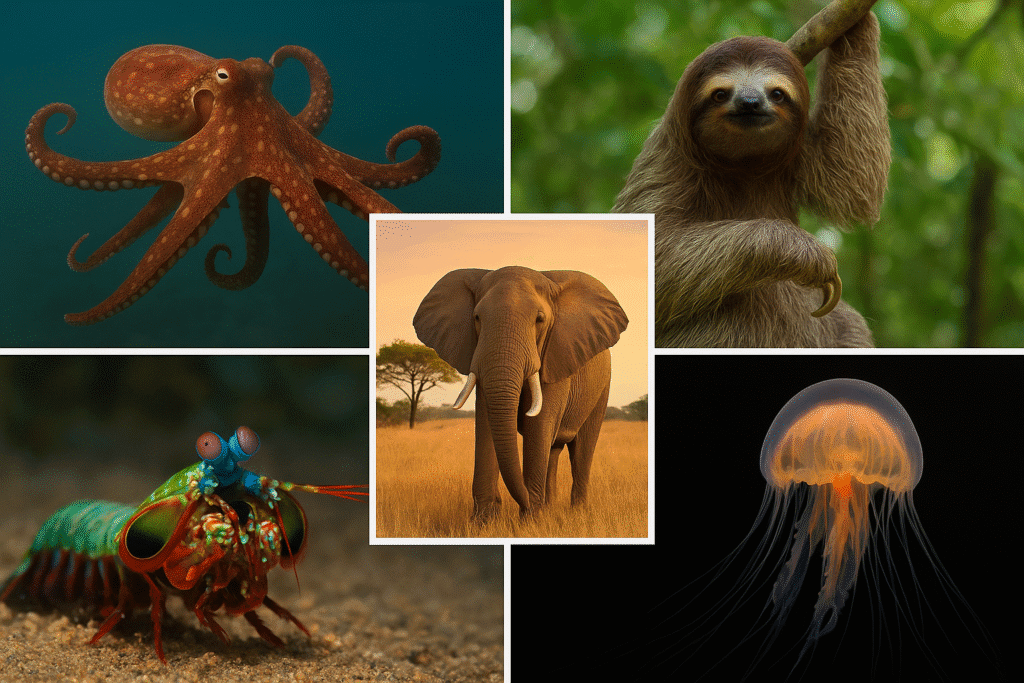
Three hearts make up an octopus: one systemic heart that circulates the oxygenated blood throughout the body and two branchial hearts that pump blood to the gills for oxygen. Because swimming is more taxing and wears them out faster, octopuses prefer to crawl because their systemic heart stops beating when they swim. Their vibrant lifestyle is supported by this system, which functions in tandem with their blue, copper-based blood.
Octopuses have three hearts, each with a unique function. Only two of their hearts pump blood to the gills, where it absorbs oxygen from the surrounding water. The oxygen-rich blood is subsequently pumped to the rest of the body by the third heart. Surprisingly, an octopus’s main heart actually stops beating when it swims, which is why they get tired easily and would rather crawl than swim. Although it sounds like something from a science fiction film, these amazing creatures’ special circulatory system allows them to survive in their underwater environment.
Sloth’s Slow Digestion
Sloths are known for their incredibly slow movements, but did you know that they also have extremely slow digestion? A sloth may not finish digesting a single meal for up to a month! Tough, fibrous leaves that are extremely difficult to break down make up the majority of their diet. Sloths are able to cope with this by having a multi-chambered stomach that is specially adapted and full of symbiotic bacteria that ferment the leaves gradually, much like cows do when they digest grass. Sloths move very slowly and rest or sleep for up to 20 hours a day because of their extremely slow digestion, which results in very little energy from their food.
Elephants Recognize Themselves
Elephants are actually able to recognize themselves in a mirror, which is a sign of self-awareness that scientists believe is uncommon in the animal kingdom. This may seem like something that only humans or a select few other animals could do. Elephants have been seen touching marks on their own bodies in mirror tests that they could only see in the reflection, demonstrating that they recognize that the reflection is of them rather than another elephant. Elephants are among the largest land animals and also among the most emotionally complex due to their self-awareness, which is typically associated with high levels of intelligence and empathy. This is a startling fact that seems almost too clever to be true, but it is.
Shrimp Punch Power
The ability of some shrimp species, known as mantis shrimp, to deliver punches so quickly and forcefully that they cause shockwaves underwater sounds like something from a superhero comic! In a split second, their claws can reach speeds of up to 50 miles per hour, snapping shut at a rate similar to a gunshot. This amazing punch has the power to instantly stun or even kill prey, as well as shatter glass aquarium walls. Even more bizarre is the fact that the force of their impact causes water to momentarily transform into plasma and emit light, a phenomenon known as “sonoluminescence” that occurs underwater. That a prawn could have this much power is almost unbelievable, but it is absolutely true.
Immortal Jellyfish
Turritopsis dohrnii, the immortal jellyfish, is a species of jellyfish that is biologically immortal because it can return to its earliest, juvenile form, a polyp, when it is stressed, injured, or aging. When this process takes place, the jellyfish changes by reversing its life cycle. It may be able to repeat this process indefinitely, preventing it from dying of old age. Reversal process: The mature jellyfish shrinks, reabsorbs its tentacles, and settles on the seafloor as a polyp in response to injury, malnutrition, or aging. After that, it may develop into another adult jellyfish. Transdifferentiation: Its cells have the capacity to undergo a process known as transdifferentiation, which allows them to change from one type to another. Researchers are looking into this to learn more about and possibly mimic human cellular repair. Life cycle: Jellyfish typically go through the following stages: egg, larva, polyp, and adult medusa. The medusa-to-polyp-to-medusa cycle can be repeated indefinitely by the immortal jellyfish. Learn more fascinating and verified weird animal facts on Science Focus.
Here’s another article you may find useful:
Most Intelligent Animals on Earth
4 Weird Animal Habits You Won’t Believe
7 Animals That Can Regrow Body Parts
Conclusion
There are many incredible marvels in the animal kingdom that contradict our preconceived notions about life on Earth. These amazing facts, which range from jellyfish that can avoid death to octopuses with three hearts, demonstrate how inventive and unexpected nature can be. As a reminder that there is always more to learn—and value—about the incredible beings with whom we coexist, the truth can occasionally be stranger than fiction. Therefore, keep in mind that an amazing animal fact could be entirely true the next time you hear it. Some animal facts that may seem fictitious but are actually true include the fact that horned lizards can shoot blood from their eyes, beavers’ teeth are naturally iron-strong, and octopuses have three hearts and blue blood. Other examples include the fact that cows form the best friendships and that koalas have fingerprints.



Pingback: 4 Weird Animal Habits You Won't Believe - Wildpaw.info
Gotta say, 444bet, you’re alright. Quick payouts which is a big plus for me. Simple interface too. Give it a whirl: 444bet.
Alright, so 3rrcom is the spot tonight. Let’s load up and see what the games are like. Hoping I’m lucky! Game On!: 3rrcom
Righto, so I logged into h666gamelogin the other night. Registration was easy enough, got stuck right in. Nothing earth-shattering but hey, good for a bit of a punt after work! h666gamelogin